Choosing Music That Reflects a Loved One at a Cremation Memorial
Key Takeaways
Start with songs and sounds that were truly part of your loved one’s life.
Memorial music can be peaceful, joyful, spiritual, familiar, or quietly reflective.
A short playlist with a clear purpose often feels more meaningful than a long list.
Confirm playback details early so technical problems do not interrupt the gathering.
Give relatives a way to contribute while keeping one person responsible for final choices.
Music That Feels Personal, Not Performative
Meaningful music begins with recognition, not with finding the “right” funeral song. Families arranging cremation services Irving, TX can choose songs, instrumental pieces, recordings, or even periods of quiet that feel like the person being remembered.
A memorial held after cremation gives families time to think beyond the first songs that come to mind. A favorite Sunday-morning record, a hymn that mattered to them, a song they played while cooking, or a melody connected to a shared trip may say more than a standard selection ever could. Music does not have to be solemn to be respectful.
It can also be simple. One song at the beginning, one during a photo tribute, and one at the close may be enough. The goal is not to perform grief for guests. It is to create room for people to recognize a life and respond in their own way.
What Would They Have Chosen Themselves?
The best musical clues are often found in ordinary routines and relationships. Begin by asking what your loved one returned to again and again, rather than what others expect a memorial to sound like.
Look through saved playlists, CDs, concert programs, or favorite radio stations.
Ask relatives what song brings a clear memory of the person to mind.
Consider faith traditions, cultural heritage, and music heard at meaningful family gatherings.
Think about hobbies, work, military service, sports, travel, or a favorite era of music.
Notice life chapters, such as a wedding song, music from a childhood home, or a song tied to a close friendship.
Include a piece that reflects humor, warmth, or resilience if that was central to who they were.
A person who loved lively jazz, classic country, gospel, or a particular singer does not need to be represented by a slow instrumental simply because it is a memorial. The selection should feel honest. Guests often respond more deeply to a familiar song that sounds like the person than to music chosen only because it seems formal.
A Clear Emotional Arc for the Gathering
Music can quietly guide a memorial from arrival through farewell. That does not mean every song must carry the same emotion. A gathering may begin calmly, move into affectionate memories, and close with steadiness or even a little lift.
Start by deciding what guests need most in each part of the service. Arrival music can soften the awkwardness of entering a room where people are grieving. Music during readings, a video, or a spoken tribute can hold attention without competing with words. The final selection can leave guests with comfort, gratitude, peace, or a sense of the loved one’s personality.
There is no required number of songs. A shorter program may need only two or three carefully placed selections. A longer celebration may have music before and after the formal remarks, plus one or two focal moments. Allowing too many songs can make the gathering feel unfocused, especially if each one has a completely different mood.
For example, a family might welcome guests with a quiet instrumental piece, use a beloved sing-along song after a eulogy, and close with a hopeful recording the person often played at home. Those choices create movement without forcing a single feeling on everyone present.
Arrival Music Sets a Gentle Welcome
Arrival music should be low enough for greetings and quiet conversation. Choose something familiar or calm, but avoid lyrics that may pull attention before the gathering begins.
This is also a good place for instrumental music, especially if relatives are still arriving or the start time may shift slightly. The purpose is not to fill every silence. It is to make the room feel cared for.
Tribute Moments Hold Focus
A tribute song works best when it has a clear role. It may accompany photos, follow a reading, or give guests a moment to sit with what was shared.
If lyrics carry an important message, provide the song enough space to be heard. Avoid placing a lyric-heavy recording under a speaker’s remarks, since guests may struggle to follow either one.
What Feeling Should Guests Carry Home?
Choose the closing music based on the feeling you want guests to leave with, not only the sadness of the day. A final song can offer peace, connection, gratitude, faith, or a reminder of the person’s spirit.
That choice may be quiet and reflective, or it may be warm and familiar. A closing song does not need to resolve grief. It simply gives the gathering a thoughtful last note.
Which Music Source Fits the Memorial?
The right music source depends on the setting, who will manage it, and how much participation your family wants. Ask the venue or provider what equipment and timing are workable before finalizing the plan.
Music Source
Personal Meaning
Practical Needs
Best Fit
Curated recorded playlist
Familiar songs and artists
Device and playback access
Flexible gathering
Live musician
Personal performance
Scheduling and space
Quiet tribute moment
Congregational singing
Shared participation
Lyrics and song leader
Faith-centered service
Instrumental background music
Calm, less distracting
Speaker setup
Guest arrival
Family member’s recording
Strong personal connection
Audio quality check
Brief remembrance
Recorded music is often easiest to manage, but it still needs a designated person who knows when each selection should begin. Live or shared music may feel especially meaningful when the setting and participants support it. The best option is the one that fits the family’s plan without creating extra stress.
Shared Choices That Reduce Family Tension
Different musical preferences are normal, especially when relatives are grieving in different ways. One person may want traditional hymns, while another wants the music their loved one played every day. Neither response is automatically wrong.
Invite a few close relatives to submit one or two suggestions, along with a sentence about why each song matters. Then appoint one person, or a small planning group, to make the final sequence. This keeps the process open without turning the playlist into a vote on every detail.
Set gentle boundaries early. You might reserve one place in the program for a spiritual selection, one for a personal favorite, and one for a closing piece. If a requested song does not fit the tone or timing, it can still be played privately at a family meal or included in a shared online playlist. Families with broader arrangement questions may also find guidance in these common cremation questions.
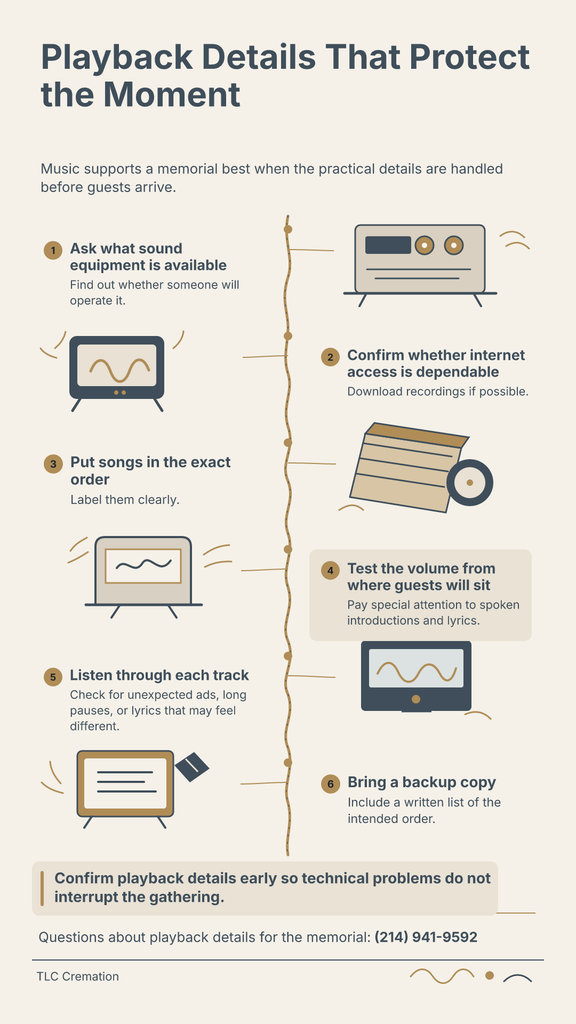
Playback Details That Protect the Moment
Music supports a memorial best when the practical details are handled before guests arrive. Confirm arrangements during the formal planning process required for final disposition in Texas, rather than assuming a device or venue setup will work as expected.
Ask what sound equipment is available and whether someone will operate it.
Confirm whether internet access is dependable, then download recordings if possible.
Put songs in the exact order they will be used and label them clearly.
Test the volume from where guests will sit, especially for spoken introductions and lyrics.
Listen through each track for unexpected ads, long pauses, or lyrics that may feel different in the memorial setting.
Bring a backup copy on another device or storage option, along with a written list of the intended order.
Music can be part of a memorial held days or weeks after cremation, and that extra time can make planning more manageable. If the larger process still feels unclear, this guide to the first steps after a death may help families organize questions before making decisions.
Choosing a Playlist Families Can Stand Behind
If you are still unsure, choose fewer songs and give each one a purpose. Ask whether the selection sounds like your loved one, supports the people gathered, and can be played reliably in the chosen setting. Those three questions are usually enough to narrow the list.
A thoughtful playlist for cremation services Irving, TX does not have to please every person in exactly the same way. It should offer a true reflection of the life being honored. TLC Cremation is available to talk through memorial choices and family questions at (214) 941-9592.
Our Reviews
Stephanie P.
Reviewed in 2025
The staff there are wonderful and helped me through the entire process! They were very patient as my family and I were going through this difficult loss!
Misty M.
Reviewed in 2025
My situation was very sudden and it's something I've never had to do before. They have helped me every step of the way and are still working with me.
Karen V.
Reviewed in 2024
When my grandmother passed away I had no idea what to do and felt so overwhelmed. I looked up 3 different funeral homes for cremation and TLC was so quick to respond.
Greta P.
Reviewed in 2024
TLC was highly recommended by our hospice social worker. This helped as make a decision on who we want to use after my husband’s death.