Living in another city or state does not prevent you from taking part in a loved one’s arrangements. With cremation services Dallas, TX, families can often coordinate information, decisions, documents, and updates without every relative needing to travel.
Key Takeaways
- Distant relatives can provide meaningful help even if one person must handle formal arrangements.
- Clear decision-making roles reduce confusion during an already difficult time.
- A simple communication plan can keep relatives informed without overburdening one family member.
- Remembrance does not have to happen immediately or in one location.
- Questions about paperwork, communication, and final return plans are worth raising early.
Distance Does Not End Family Participation
Being far away can bring a painful feeling of helplessness. You may want to be present, hear every update, and support the relative closest to the arrangements, yet work, health, travel limits, or family responsibilities may make that impossible.
Remote family members can still contribute in practical ways. The most helpful approach is usually to decide who will communicate with the provider, who will gather family information, and who will share updates with others. That structure gives the person handling arrangements support instead of leaving them to manage every call and message alone.
TLC Cremation offers an online arrangement process, which may make participation more manageable for authorized family members who cannot be physically present. Distance does not erase a relative’s place in the family’s goodbye. It simply changes how that support is offered.
What Happens During Direct Cremation?
Cremation is a form of final disposition, meaning the process addresses a loved one’s physical care after death. A separate gathering, tribute, or time of remembrance may be planned later, if the family chooses.
The arrangement process generally includes confirming the person authorized to make decisions, completing required documentation, providing vital information, and choosing how cremated remains will be received. These steps can feel administrative, but they are part of treating the person who died with care and attention.
Final Disposition Requirements
Texas requires each person who has died to go through a formal arrangement process so a final form of disposition can be established. Burial, cremation, entombment, and removal from the state are examples of final disposition.
The authorized family member should be prepared to provide accurate personal details and respond to requests for documents or signatures. Distant relatives can help find information, but they should avoid sending conflicting instructions to the provider.
Separate Memorial Decisions
A remembrance gathering does not have to be settled before cremation arrangements move forward. Families often need more time to coordinate travel, choose a date, or decide what would feel meaningful.
That separation can relieve pressure. A family may focus first on the necessary arrangements, then discuss a meal, a private gathering, an online tribute, or a future memorial when relatives can be together. Families considering their choices may also find it useful to review common cremation planning questions.
Remote Family Roles
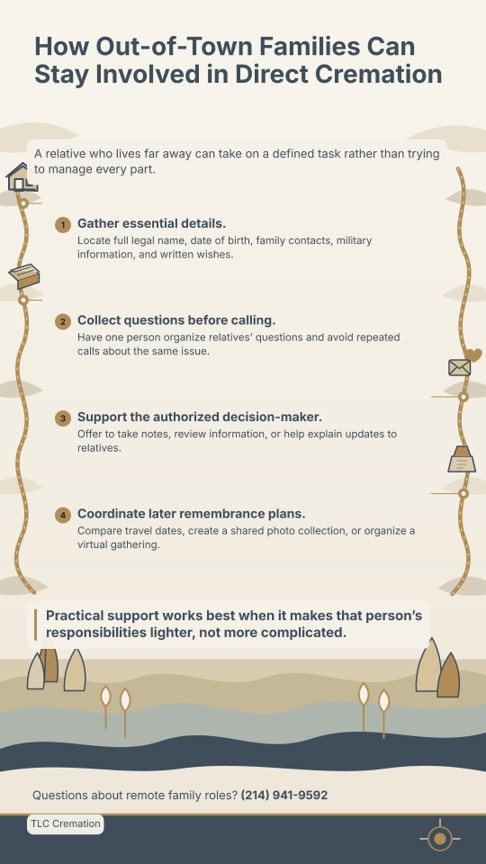
A relative who lives far away can take on a defined task rather than trying to manage every part of the process from a distance. Start by asking the arrangement contact what would actually be helpful.
- Gather essential details. Locate the loved one’s full legal name, date of birth, family contacts, military information if applicable, and any written wishes that may guide the family.
- Create one family contact list. Include the people who should receive updates, along with the best phone number or email address for each person.
- Collect questions before calling. Ask relatives to send questions to one person, who can organize them and avoid repeated calls about the same issue.
- Support the authorized decision-maker. Offer to take notes during calls, review information they receive, or help explain updates to relatives.
- Coordinate later remembrance plans. A distant relative may be well suited to compare travel dates, create a shared photo collection, or organize a virtual gathering.
Authority and documentation needs can vary by family situation, so the person making arrangements should confirm what is needed directly with the provider. Practical support works best when it makes that person’s responsibilities lighter, not more complicated.
Who Makes Decisions From Afar?
The person with authority to make final disposition decisions may be able to complete arrangements from afar, but the family should identify that person early. Waiting for every relative to agree can delay communication and place unnecessary strain on the person closest to the situation.
Authorized Decision-Making
The authorized decision-maker is the person recognized as able to give instructions and complete required arrangements. That person may not be the relative who lives nearest, pays for arrangements, or speaks most often in the family group chat.
Families should ask the provider which documents and authorizations are needed for their circumstances. It is wise to clarify this before relatives begin making assumptions or sharing different preferences. A calm, early conversation can prevent hurt feelings later.
Shared Family Input
Other relatives can still have a voice, even when they are not the person completing the arrangements. The key is to share input with the authorized decision-maker, rather than treating every preference as a separate instruction to the provider.
For example, siblings living in different states may agree that one sibling will handle formal communication, while the others collect obituary details, family photos, and ideas for a later gathering. That division respects everyone’s relationship while keeping the process clear. For more guidance on weighing simple arrangements, read about considerations before selecting cremation.
Communication Plans for Distant Relatives
A communication plan should fit the family, not create another task that feels impossible. The following options can help relatives choose a method that keeps updates organized.
| Update Method | Best Use | Main Benefit |
|---|
| Group text | Short updates | Quick and familiar |
| Shared email | Detailed information | Easy to reference later |
| Family contact person | Larger families | Fewer repeated calls |
| Scheduled video call | Major decisions | Space for discussion |
| Shared document | Dates and tasks | One central record |
Choose one primary method and tell everyone which person will use it. If a family member has urgent concerns, they can direct them to the designated contact instead of expecting the arrangement provider to manage many separate conversations.
Questions for Cremation Services in Dallas
Clear questions can help distant relatives understand their role before confusion develops. Ask the provider how remote participation works, what information must come from the authorized decision-maker, and how the family will receive updates.
It is also reasonable to ask which selections are necessary now and which can wait until the family has had time to talk. Families should receive information in plain language, especially when grief makes it hard to process details quickly. TLC Cremation focuses on straightforward cremation arrangements and transparent information, which can be especially important when relatives are coordinating from different places.
Can Documents Be Handled Remotely?
Ask which documents may be completed online or through other remote methods, and which information the authorized person should have ready. Confirm how signatures, identification, and returned forms should be handled before assuming travel is necessary.
A family member living elsewhere can often help gather information, review forms with the authorized person, and keep a record of what has been completed.
How Will Updates Be Shared?
Ask who at the provider will communicate with the family and whether updates will go through one designated contact. Clarify what types of updates the family can expect and how to reach the provider if new questions arise.
This is also a good time to ask how the family will be notified once the cremation process is complete and what arrangements are available for receiving the cremated remains.
What Costs Should We Review?
Ask for a clear explanation of what is included in the selected arrangement and what choices are optional. Understanding each item before making a decision can help relatives avoid misunderstandings, especially when several people are contributing opinions from afar.
A provider should be able to explain the process without pressure. If something is unclear, ask for it to be explained again in simpler terms.
Meaningful Involvement After the Cremation
The end of the disposition process does not have to mark the end of family participation. A later gathering may give relatives time to travel, while a smaller local remembrance may feel right for those who cannot wait.
Families can share stories through a group video call, gather photographs for a digital album, write letters to be read privately, or choose a future date to meet in person. There is no required timetable for honoring a life. Some people need an immediate opportunity to connect, while others find that a quieter gathering weeks or months later feels more manageable.
Being out of town should not leave you feeling shut out of the goodbye. Thoughtful planning around cremation services Dallas, TX can give each relative a clear place in the process, whether that means helping now or joining a remembrance later. TLC Cremation is available to talk through family communication and arrangement questions at (214) 941-9592.